Why New York’s Fashion Act keeps stalling in Albany
New York's Fashion Act would force big retailers to map supply chains and cut emissions, but four years on it still hasn't reached a floor vote.
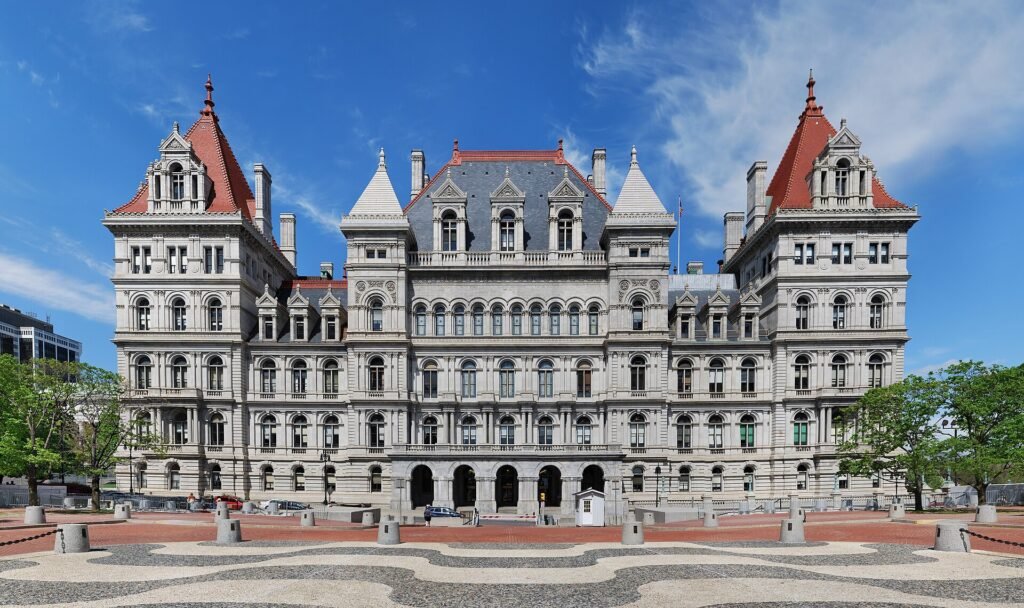
A bill that would make New York the first state to force major fashion brands to disclose their supply chains and cut greenhouse gas emissions is sitting in an Albany committee for a third straight legislative session, with no floor vote in sight.
The Fashion Sustainability and Social Accountability Act, known as the Fashion Act, has been introduced in every legislative session since 2022. Its current version, S4558B in the Senate and A4631B in the Assembly, was last acted on when the Assembly bill was referred back to the Consumer Affairs and Protection Committee on January 7, 2026. Meanwhile, comparable bills in three other states have already failed or stalled in 2026, leaving New York’s the furthest along of any state effort so far.
What the Bill Would Require
The Fashion Act applies to companies selling apparel, footwear or fashion bags in New York with more than $100 million in annual revenue. Covered companies would have to map their supply chains across four production tiers, from finished-goods manufacturers down to raw material suppliers, according to the bill text on the New York State Senate’s website.
Disclosure would be phased in over time: companies would need to identify 85% of their Tier One suppliers by volume within 12 months of the law taking effect, scaling down to 50% of Tier Four raw-material suppliers within six years. Companies would also have to conduct environmental due diligence, set science-based greenhouse gas reduction targets aligned with the Paris Agreement covering Scopes 1, 2 and 3 emissions, and report annually starting in 2027 with independent verification every two years.
A separate chemical-management provision would require significant dyeing and finishing suppliers to report wastewater chemical concentrations within two years. Annual due diligence reports would go to the New York Department of State and be posted online in machine-readable form.
Fashion’s carbon footprint
The New Standard Institute, the nonprofit that helped draft the Fashion Act, has cited the fashion industry as responsible for an estimated 4% to 8.6% of global greenhouse gas emissions.
Penalties Have Shrunk Since 2022
The bill’s teeth have changed considerably since it was first introduced. The original 2022 version, S7428/A8352, proposed fines of up to 2% of annual revenue for companies with $450 million or more in sales, following a notice and a three-month cure period, according to the bill text hosted by the Senate.
The current version caps civil penalties at $15,000 per violation per day, enforced by the state Attorney General. Penalties in both versions would flow into a fund for environmental and social remediation projects, called the Community Benefit Fund in the original bill and the Fashion Remediation Fund in the current one.
Four Sessions, No Floor Vote
The Fashion Act was first introduced on January 7, 2022, with State Senator Alessandra Biaggi and Assemblymember Anna Kelles as prime sponsors. It was reintroduced in 2023 for the next legislative session.
The bill’s furthest advance came on June 7, 2024, when it passed the Assembly’s Ways and Means Committee in the final hours of that year’s legislative session, according to a WWD/Sourcing Journal report. By then it had more than 90 legislative co-sponsors. It still did not reach the Assembly floor for a vote before the session ended. Maxine Bédat, executive director of the New Standard Institute, the nonprofit that helped write the bill, said at the time that supporters had “ran out of time” that session.
The bill was reintroduced for the 2025-2026 session with Senator Brad Hoylman-Sigal as prime Senate sponsor and Kelles again sponsoring in the Assembly. Each chamber’s bill was amended twice in 2025 and recommitted to committee both times. The Assembly version was referred back to committee again on January 7, 2026; the Senate version’s most recent recorded action is from April 7, 2025. Neither has reached Ways and Means or the floor this session. New York bills run on two-year cycles that begin in odd-numbered years, meaning the current bill could still be acted on before the cycle ends, though unacted bills can also be eliminated if they miss procedural deadlines.
The bill’s furthest advance came in June 2024, when it passed a key Assembly committee in the final hours of the session, then went nowhere.
Other States Try, and Stall
New York is not alone in pursuing this kind of law, and it is not alone in struggling to pass one. California’s version, AB 405, the Fashion Environmental Accountability Act of 2025, was introduced by Assemblymember Addis on February 4, 2025, and amended three times before being referred to the Assembly Appropriations Committee’s suspense file. A scheduled May 2025 hearing was postponed, and the bill was held under submission at a January 22, 2026 hearing before dying on January 31, 2026, when it missed a state constitutional deadline for clearing committee, according to the bill’s official status page on the California Legislature’s website.
Washington’s equivalent, HB 1107, missed that state’s February 17, 2026 cutoff for passing its house of origin. Massachusetts’ version, H.1032, received a study order for continued committee review rather than an outright death, though a legal analysis published by the National Law Review noted that most bills sent to study orders never emerge from them.
What Happens Next
For now, the Fashion Act remains in committee in both the New York Senate and Assembly, with no scheduled hearing or floor date reported. Supporters have framed each session’s setback as a step toward eventual passage rather than a defeat, pointing to the growing co-sponsor list as evidence of momentum.
The stakes cited by the bill’s backers are tied to the scale of the fashion industry’s environmental footprint. The New Standard Institute, in its original 2022 release introducing the bill, cited fashion as responsible for between 4% and 8.6% of global greenhouse gas emissions. If the current session ends without a vote, legal analysts monitoring the bill have said it could be reintroduced again, continuing a pattern now in its fifth year.
Photo: This image or media was taken or created by Matt H. Wade . To see his entire por · CC BY 3.0 · via Wikimedia Commons