How Luxury Brands Are Financing Costumes, and What Designers Give Up
Luxury conglomerates are financing films and shaping wardrobes, raising questions about costume designers' creative control and screen credit in the industry.
Tiffany & Co. became the first luxury jeweler to partner with Netflix, providing 27 pieces from its archives for Guillermo del Toro’s *Frankenstein*. Costume designer Kate Hawley incorporated these pieces into costumes worn by actress Mia Goth. The collaboration exemplifies a fundamental shift in how films get financed and dressed: luxury houses are moving beyond sponsorship to become production investors and creative partners, reshaping the economics of costume departments.
This trend emerged as decreased funding from major streaming platforms created a financing gap that luxury brands are now filling. Rather than traditional product placement, where branded goods appear incidentally, luxury conglomerates are establishing dedicated film production divisions, co-financing projects, and embedding their aesthetics into costume design itself. The shift blurs lines between costume design and marketing in ways that raise urgent questions about designer control, compensation, and screen credit.
Why luxury brands entered film financing
Streaming platforms fundamentally altered film financing. As Netflix and other streaming platforms reduced investment in independent film and certain production categories, luxury conglomerates recognized an opportunity. Unlike traditional film investors dependent on box office returns or audience performance, luxury brands can absorb commercial uncertainty because their strategic interest lies in cultural positioning rather than revenue. A film can fail commercially and still succeed in building brand prestige and reaching affluent, culturally-engaged audiences.
Saint Laurent pioneered this model in 2019 when it established Saint Laurent Productions, becoming the first fashion house to launch a full-scale film production subsidiary rather than merely sponsoring projects. The company, owned by Kering, has funded six short and feature-length films to date. LVMH also recently launched its own entertainment division. Lacoste’s entertainment arm co-produced filmmaker Cédric Jimenez’s *Chien 51*. Chanel has worked behind the scenes on films including *Priscilla*, *Wuthering Heights*, and *How to Make a Killing*. These initiatives reflect luxury’s strategic evolution from consumer goods toward what the industry calls “soft power”—using film as a vehicle for cultural authority and artistic legitimacy.
The Tiffany-Frankenstein collaboration
Tiffany & Co. provided 27 pieces of jewelry from its archives for Guillermo del Toro’s Frankenstein, marking the first partnership between a luxury jeweler and Netflix. Costume designer Kate Hawley won the Academy Award for Best Costume Design for the film.
How the financial model works
Luxury brand partnerships address a concrete budget problem. When Saint Laurent or Tiffany provides costumes and accessories, they reduce that line item substantially. A costume designer like Kate Hawley or Virginie Montel negotiates access to luxury archives—rare pieces, custom fabrications, and high-jewelry items that would otherwise require independent sourcing and fabrication budgets. For a period drama like *Frankenstein* or *Emilia Pérez*, archival pieces offer both historical authenticity and production cost savings.
The financial arrangement operates as exchange. Brands gain on-screen visibility integrated into narrative storytelling rather than as isolated product placement. When Mia Goth wore Tiffany jewelry in *Frankenstein*, the pieces expressed character rather than advertising the brand; yet Tiffany simultaneously built cultural association with del Toro’s artistic vision and received prominent display at its Fifth Avenue flagship and in an exhibition in London. Saint Laurent dressed actors in *Emilia Pérez* while receiving co-production credit, guaranteeing creative input and brand positioning. This model differs fundamentally from the historical approach: Patricia Field partnered with Chanel, Valentino and Calvin Klein for *The Devil Wears Prada*, but Chanel provided $2 million worth of diamonds for Jacqueline Durran’s costumes in *Anna Karenina*—transactions negotiated case-by-case rather than as systematic production financing.
Creative integration on set
When luxury brands move beyond sponsorship into production, they gain formal creative authority. Anthony Vaccarello, creative director of Saint Laurent, received an official credit as “costume artistic director” on *The Shrouds*, a David Cronenberg film, signaling that his creative role extended beyond wardrobe provision. Virginie Montel served as costume designer on *Emilia Pérez*, working through Saint Laurent’s archives to source costumes while shaping the film’s visual language. Kate Hawley collaborated with del Toro and Tiffany’s design team to select pieces that would express each character’s psychology and the film’s visual themes. On *Challengers*, Loewe’s creative director Jonathan Anderson made his costume design debut, creating pieces that became retail offerings after the film’s release, linking narrative directly to commercial strategy.
This integration raises the stakes for costume designers. They must balance their own artistic vision—character development, historical accuracy, visual storytelling—against the brand’s commercial and aesthetic interests. Costume departments must manage relationships with luxury brand representatives, navigate creative compromises, and work within an archival framework that may not offer ideal options for every scene. The costume designer remains responsible for the overall visual coherence and narrative function of costumes across an entire production, yet shares authorship with a brand whose interests, while often aligned, may diverge on specific choices.
The Tiffany-Frankenstein collaboration as model
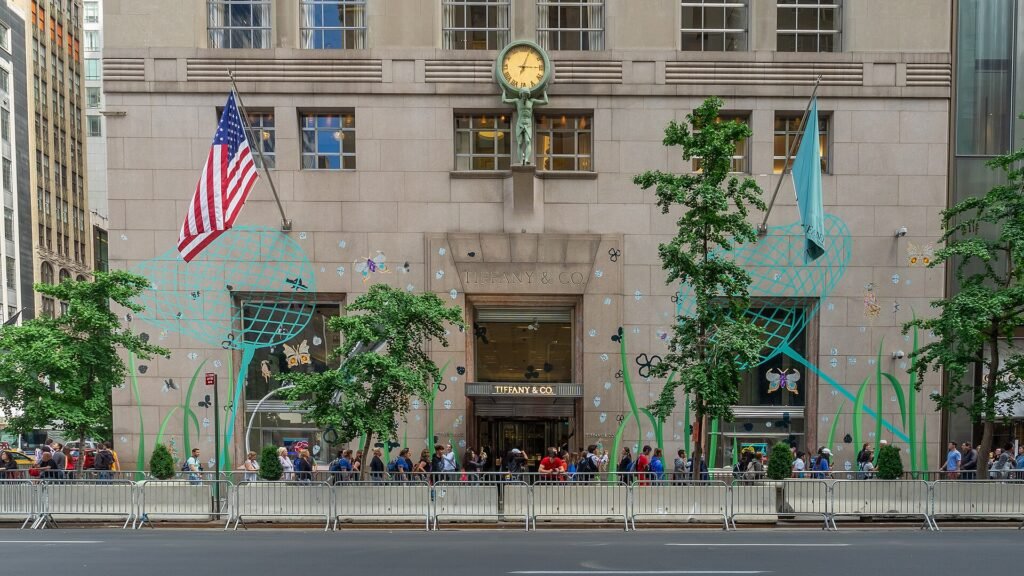
The Tiffany partnership illustrates how luxury-brand integration works at scale. Tiffany provided not merely jewelry but a full marketing and cultural apparatus: window displays at its Fifth Avenue flagship, an exhibition at the Old Selfridges Hotel in London, QR codes linking consumers to behind-the-scenes content, and integration of the film into Tiffany’s brand narrative around craftsmanship and heritage. Kate Hawley won the Academy Award for Best Costume Design for the film.
The collaboration generated significant marketing value for Tiffany while providing Hawley with access to 27 archival pieces. Yet this benefit came with creative constraints: Hawley worked within Tiffany’s existing archives rather than commissioning entirely original pieces. The jewelry had to meet both narrative requirements and brand aesthetic standards. For productions less prestigious than *Frankenstein*, the balance between creative autonomy and brand partnership becomes more precarious.
Without institutional guardrails, luxury partnerships could systematically diminish designer visibility and professional recognition in an industry where production financing increasingly comes with creative strings attached.
Concerns about designer control and credit
The Costume Designers Guild has begun pushing back against arrangements where brand partnerships overshadow individual designer contributions. Designers risk losing narrative credit for their creative choices when a brand’s name dominates marketing materials and press releases. A costume designer may spend months conceiving character arcs through wardrobe evolution, only to have press emphasis the brand partnership rather than the designer’s conceptual contribution.
In some cases, costume designers receive credits onscreen, but behind-the-scenes discussions emphasize the brand’s artistic direction, affecting public perception and professional standing. For productions where a designer must work primarily within a brand’s existing archives or meet aesthetic expectations set by the brand’s creative director, the constraints on artistic autonomy become particularly acute. The union has not yet negotiated explicit new contract terms addressing these partnerships, though industry evolution signals that such negotiations may become necessary. Without clear contractual protections, costume designers operating under brand partnerships face potential disadvantages in awards consideration, future employment prospects, and professional recognition compared to designers working on independently financed productions.
Industry response and emerging standards
The guild’s recent partnership with Bvlgari on a reimagined statuette for its 2026 awards ceremony—set for February 12, 2026—signals an attempt to assert costume design’s primacy even as luxury brands become embedded in production financing. The collaboration ironically reflects the reality that costume design and luxury partnerships have become difficult to separate in contemporary filmmaking. Rather than resist the trend, the guild negotiated a luxury partnership itself, positioning luxury engagement within a professional framework.
Yet this arrangement also suggests the guild views current arrangements as insufficient protection for members’ professional standing. Saint Laurent Productions has funded six films to date and plans to maintain that output, indicating the model will continue expanding. As LVMH, Kering and other conglomerates launch entertainment divisions and allocate significant capital to film, costume designers will increasingly negotiate with brand representatives. The absence of standardized contractual language addressing brand partnerships means each production negotiates terms independently. The guild’s emphasis on proper credit—ensuring costume designers receive screen recognition separate from brand logos—reflects concern that without institutional guardrails, luxury partnerships could systematically diminish designer visibility and professional recognition in an industry where production financing increasingly comes with creative strings attached.
Photo: Ajay Suresh from New York, NY, USA · CC BY 2.0 · via Wikimedia Commons